
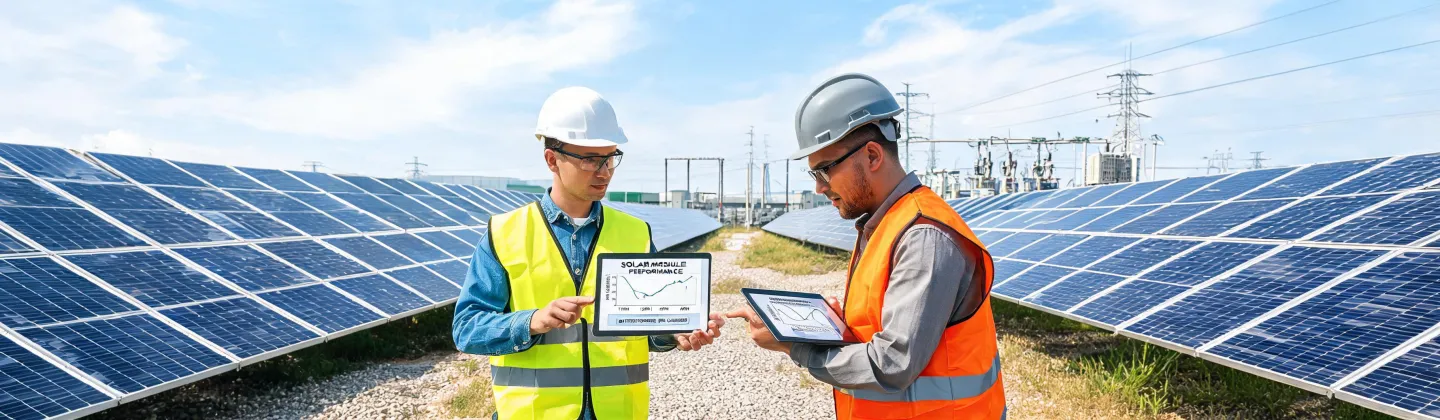
It was a gray Tuesday in early March when I found myself in a dim warehouse in La Grange Park, staring at a pallet of solar modules that didn't look right. Nothing dramatic—the boxes were intact, the labels were clean. But something felt off. I've spent four years reviewing equipment before it ships to customers, and my gut was telling me to look closer.
That pallet was supposed to hold 220 pieces of 560W Jinko Tiger Neo panels from a distributor we'd been using for years. Same model number as the sample I approved back in January. But when I ran my I-V tester across the first module and compared it to the manufacturer's datasheet, the numbers were slightly off. Not catastrophically. Just enough to matter.
I assumed "same product" meant "same everything." That was my first mistake.
The project that brought me there
I'm a quality and compliance manager for a mid-sized solar integrator. I don't sell systems, I don't install them. I make sure the equipment matches what we promised the customer. In Q1 2024, I reviewed about fifty deliveries—panels, inverters, racking, batteries. That's a fair amount of trust to place in suppliers.
This particular project was a commercial mixed-use building in La Grange Park: 120 kW of rooftop solar, four Level 2 EV chargers, and a 60 kWh battery bank. The owner wanted net-zero claims that were defensible. He said at the kickoff meeting,
"we don't want to be the company that puts solar on the news for the wrong reasons."That should've been my first clue about how serious this client was.
The distributor problem
The panels were straightforward. We specced Jinko Tiger Neo 560W modules—N-type TOPCon, JinkoSolar's flagship line for commercial projects. Good temperature coefficient, solid degradation warranty, and the modules are available through just about any major distributor. JinkoSolar is rated Tier 1 by BloombergNEF, which happened to be a requirement in our client's procurement criteria.
We ordered through a distributor I trusted. I didn't think twice. Lead time was quoted at six to eight weeks.
Here's where the assumption came in: I expected the distributor to pull from JinkoSolar's current production stock. Turns out they had older warehouse inventory from a previous production batch. Same 560W rating, same Tiger Neo branding. But the operating voltage window was slightly different—enough to change our inverter string sizing. On paper, the modules looked correct. In practice, the system would've underperformed by maybe 7% for thirty years.
I flagged it. The distributor said, "it's within industry tolerance." Technically true. But the contract specified the exact model number, not "something close."
So we rejected the batch. I say "we" because I don't make those calls alone—it's my team's reputation on the line. The rejection cost two weeks. The distributor redid the order at their cost. But those two weeks set off a chain reaction.
Two weeks lost, then the racking decision
With the timeline compressed, the racking system suddenly became critical. The building had a standing seam metal roof, and the original design used a rail-based PV panel racking system—one we'd used on a dozen projects. Solid, proven, maybe slightly over-engineered. But the racking vendor quoted a three-week lead time.
The client's construction schedule didn't have three weeks.
So we looked at alternatives. A rail-less clamp system that mounted directly to the standing seam. Faster lead time, slightly higher hardware cost, and honestly—a cleaner look. I went back and forth for days. The rail system was proven. I'd seen it on 30+ roofs. The rail-less system was newer. Good test data, credible manufacturer, but I hadn't audited it on a real installation.
What swung the decision was one phone call. I asked the manufacturer: "show me a structural engineer's calc for this exact roof profile." They sent it within twenty-four hours. The clamp's pull-out rating was actually better than the rail system's clips on this specific seam profile.
So we switched. It cost about two percent more in hardware, but it saved the schedule. More importantly, the engineering said it was the right call. I've learned that when you're forced into a decision, that's exactly when you verify harder—not faster.
The battery question everyone asks but few answer well
Three weeks into the revised schedule, the client's facilities manager asked me a question: "How do we stop a lithium battery fire if one happens?"
I've heard this a lot. And some of the answers this industry gives make me uncomfortable. I've seen sales reps tell customers "batteries are safe, don't worry about it." That's not just misleading. It's dangerous.
The honest answer has three layers.
Prevention. Start with a battery system that's UL 9540A listed. That listing means the system has been tested for thermal runaway propagation. Our original spec didn't include it—the battery vendor we had at the time didn't offer a listed system at this capacity, and we were about to accept that.
Containment. NFPA 855 gives clear spacing requirements for battery installations. Our planned placement was too close to a firewall penetration. We moved the battery and added ventilation. That wasn't expensive, but it required coordination with the architect.
Suppression. A standard ABC extinguisher won't reliably stop thermal runaway in a lithium battery pack. We brought in a fire protection engineer to design a targeted suppression system for the enclosure.
That added $14,000 to the project. The client approved it without pushback. Reading that back, maybe it doesn't sound like much. But for a project hitting budget pressure, it was a meaningful decision.
I'll be honest: I'm not a fire protection engineer. I had to say "I don't know" on several specifics and defer to someone who did. That, I think, is also part of quality—knowing where your own knowledge ends.
The EV charger side of the equation
The four Level 2 EV chargers looked simple. Two dual-port units, 240 volts, hardwired to a subpanel. But the subpanel sat on the opposite side of the building from where the chargers needed to go. The initial electrical estimate assumed 120 feet of conduit. It was actually 190 feet. That added about $8,200 to the install.
And here's where I almost made the bigger mistake: I treated the chargers as separate from the solar and battery scope. They're not. They all feed the same service.
When I finally looked at the combined load, it hit me—our bus bar was undersized. If all four chargers pulled max current on a cloudy day, the battery would try to supplement while the PV wasn't producing, and the combined draw could trip the main breaker. That's a system that looks fine on paper but fails when you actually need it.
We upsized the bus bar and added a load management system that staggers charging when demand spikes. Cost: $3,400. It should've been caught in the initial design. I won't pretend otherwise.
Where it landed
Total damage: about 5.5% over original budget. The rejected panels cost two weeks. The racking switch cost a little more in hardware but saved the schedule. The battery safety upgrades cost $14,000. The charger redesign cost $3,400.
But the system went online in April 2024. It's producing at 103% of expected yield—I checked the monitoring data this morning. The client has referred two other developers to us since then.
Here's what I keep coming back to: the project probably would've worked with the old inventory panels. The rail racking would've been fine too, likely. The battery might've been safe, maybe. But the client didn't pay for probably, likely, or maybe. They paid for defensible net-zero claims and a building that isn't going to burn down. Quality is what makes those words hold weight.
A few lessons from this one:
- Verify everything. Even from distributors you trust. Even for products you've used before. The cost of verification is hours. The cost of a bad batch is weeks.
- Question split scopes. When solar, batteries, and EV chargers feed into one service, they interact. If nobody does a combined load calculation, it's a coin flip.
- Don't slide on battery safety. If someone asks you how to stop a lithium battery fire, the answer is UL 9540A, NFPA 855, and a real suppression plan. Not a shrug.
- Quality is what you don't catch. The modules looked right. The labels looked right. If I hadn't tested them, the system would've underperformed silently for decades. Nobody would've known why.
We now include an I-V verification protocol on every incoming order. It sounds like an obvious practice, but honestly, we'd been inconsistent about enforcing it before this project. Now it's a documented step, not a suggestion.
The client in La Grange Park got their system. The Jinko Tiger Neo panels are producing, the EV chargers are running, and the battery is sitting at 74% state of charge today, doing exactly what it's supposed to do.
I think about what would've happened if I'd trusted the labels. And that, more than anything, is why I do what I do.