
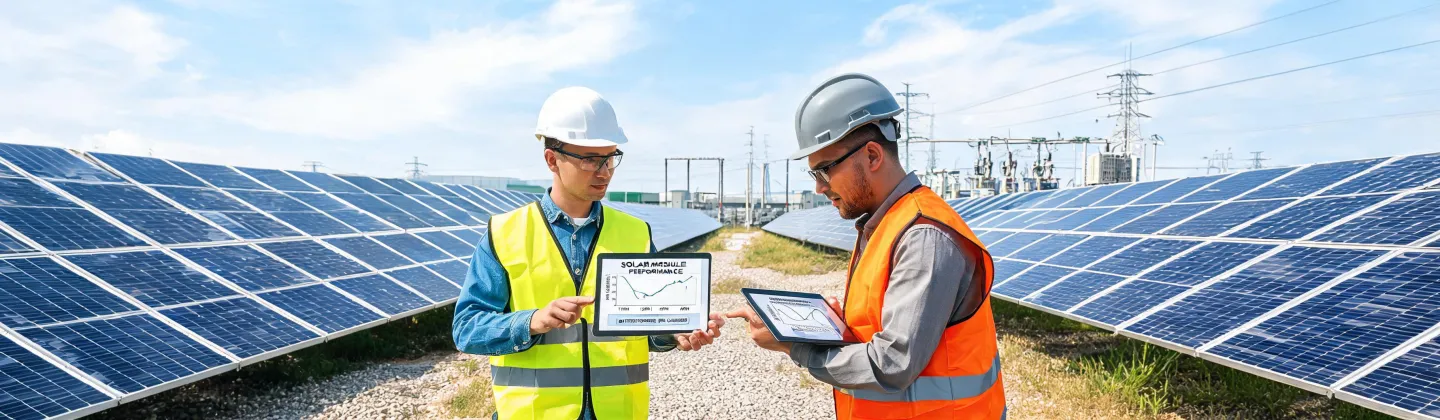
In 2023 I sat across from a small commercial developer and got asked a question I had probably answered a hundred times: “Which should we use — Jinko vs Longi solar panels?”
I launched into a full breakdown. Manufacturing quality, efficiency curve, packaging, logistics. I even pulled up two datasheets and compared temperature coefficients.
The developer let me finish. Then he said, “Okay, but I just found out the parcel next door isn’t for sale. Can this system still meet the utility’s storage requirement?”
I didn’t have an answer. That was the moment I realized the Jinko vs Longi question was the wrong question — and I had been answering it for years without noticing.
Why “Jinko vs Longi” Is a Trap
Let me start by saying something that might sound like a weak position: Jinko solar panels are good. Longi solar panels are also good. Neither is an obvious winner in most commercial and utility projects.
The phrase “Tier 1” gets thrown around like a quality certificate. It isn’t. It’s a bankability label that comes from financial strength and track record. It tells you the manufacturer is probably not going to disappear in the middle of your warranty. It doesn’t tell you whether a 620 W panel fits your racking, your inverter voltage window, or the 1.5-acre lot you have to work with.
When I focused on brand, I was winning the comparison on the datasheet but ignoring the project on the ground.
The module is a component. The system is a set of constraints. Comparing components before analyzing constraints is how expensive mistakes get funded.
Another thing started bothering me. Almost every week someone asks “What does hybrid inverter mean?” in the same conversation as the module comparison. That’s a red flag — not because it’s a dumb question, but because inverter architecture should be settled before module brand becomes relevant.
So let’s answer it once: a hybrid inverter is a single unit that manages both solar PV input and battery storage input, connects to the grid, and in most cases provides backup power when the grid goes down. It’s not just an inverter with a battery port. Control logic, transfer switching, and allowable backup loads are all part of the package.
If you’re comparing Jinko vs Longi before knowing the hybrid inverter’s DC input limits and charging curve, you’re picking tires for a car whose transmission isn’t specified yet.
The Land Problem No One Brings Up
Here’s where the question gets even more dangerous. On utility projects, the module manufacturer often matters less than the footprint of the whole system — especially once batteries are involved.
For years I glossed over battery storage MW per acre. I thought battery storage was compact. What’s the big deal? The big deal is that MW per acre depends on storage duration, container spacing, transformer placement, and local fire code requirements.
A typical containerized lithium-ion system might sit somewhere between 5 and 20 MW per acre, depending on how long the batteries are sized to discharge. Two-hour systems are denser than four-hour systems. But quoting a generic number without checking setbacks is risky. I’ve seen a 60 MW / 240 MWh facility look fine on paper and then lose 25% of its land to access roads and clearance requirements. NREL’s utility-scale solar land-use data is useful context for the PV side; for batteries, local requirements usually move the number more than the average does.
If you’re building a hybrid solar + storage plant, you need to solve storage density before picking modules. Otherwise you’ll design a plant you can’t actually build on the site you actually own.
The Price of Answering the Wrong Question
Let me give you three examples from my own track record, because this isn’t a generic industry theory.
In Q3 2022, a developer asked me to compare Jinko and Longi for a 5 MW ground-mount system with a 10 MW / 40 MWh battery. I spent two weeks building the panel comparison. The project later failed the site plan review because the designated parcel couldn’t fit enough containers to meet the MWh target — even though the MW per acre number looked okay on paper. The redesign cost about $14,000 in engineering fees and added three weeks to a schedule the developer couldn’t afford. I still kick myself for not checking usable acreage before jumping into module specs.
Another one: I went back and forth between two panels for a 220 kW project in 2019 for way too long. On paper, one was slightly more efficient. The other had better physical dimensions for the roof. I chose the efficient one and then spent more than the efficiency gain on custom racking. The lesson wasn’t about panels. It was about deciding dimensions and inverter architecture first.
There’s also a small-order angle that gets ignored. I’ve seen distributors wave off small developers with “just buy the Jinko 550W — everyone does.” When I was starting out, the vendors who treated my 30 kW order like a real project are the ones I still buy from today. Small doesn’t mean unimportant — it means potential.
The Order I Use Now
I stopped answering the Jinko vs Longi question first. Here’s the sequence I use now. It’s not sexy, but it saves money:
- Define the site. Actual square footage, roof pitch or ground slope, setback requirements, and the land left after wetlands, utilities, and easements are subtracted. If storage is in the design, test the battery storage MW per acre number against the parcel.
- Define the grid and load. Interconnection voltage, export limits, backup needs, and tariff structure. This tells you whether a hybrid inverter is the right approach and what DC/AC ratio you should design for.
- Pick the inverter architecture. Then calculate string sizes, voltage windows, and battery coupling. If you still need to ask “what does hybrid inverter mean,” this is the exact moment to ask it.
- Choose the module. This is where Jinko vs Longi finally matters. Match the panel to the inverter input voltage, available area, and budget. JinkoSolar’s N-type 580 W module is a solid fit for many projects. So are good panels from other Tier 1 manufacturers. The correct one is the one that fits your numbers.
That last step feels anticlimactic to clients, and I get it. Arguing about module efficiency is more fun than measuring a property line. But the boring answer is the one that ships.
One more honest confession: I’m a land-based solar person. If someone asks me how a project compares with offshore wind, I’ll tell them I’m not the right person for the offshore wind turbine foundation installation side of that comparison. That area has its own specialists, and they’re further from my checklist than you might think.
This sequence works for the projects I do — rooftop and small utility-scale, usually on tight property lines. If you’re working on a 100 MW site in a different market, your constraints will be different. The sequence should still hold, but the numbers won’t.
So next time someone asks about Jinko versus Longi, I don’t launch into a panel-only showdown. I ask what the ground looks like, what the inverter is doing, and how many acres are actually available. That’s the real obstacle.