
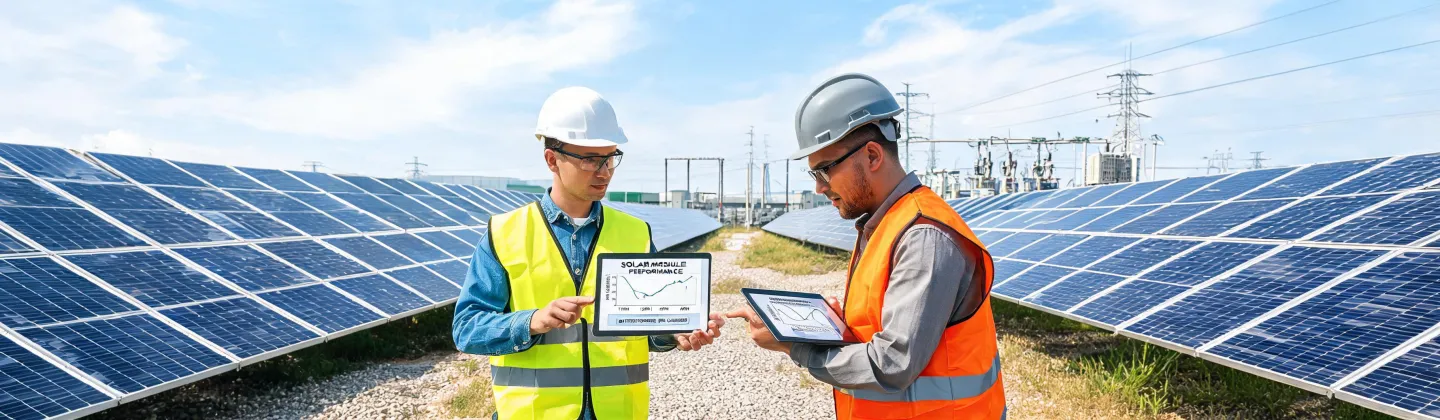
It started with a two-line email from our COO in early February 2024:
"Employees keep asking about EV chargers in the lot. The board wants us to look at solar. Can you handle this and have options by Q2?"
I'm the office administrator at a 140-person distribution company in Los Angeles. I've managed purchasing for five years—roughly $500,000 a year across 30-plus vendors. "Can you handle this?" is management-speak for "this is now your entire job." So I handled it. If you're a facilities person handed a "sustainability project" without an engineering degree, here's what I learned about JinkoSolar Tiger Neo N-type panels, a Victron backup inverter, EV charger installation in Los Angeles, and why rooftop wind didn't make the cut.
Solar panels are not a wattage race
My first instinct was standard purchasing behavior: get three quotes, compare specs, pick the best value. It's tempting to think the decision is just wattage and price per watt. That's the oversimplification that trips up first-time buyers—and it nearly tripped me up too.
The first bid came from an installer who quoted "580W modules" without a manufacturer's name. Good specs, good price. But when I pressed for who actually made them, he named a parent company that had been through a restructuring—new entity, unclear who backs the warranty. The second bid specified Jinko Solar, which sent me searching "jinko-solar," "jinko solar us," and "jinko solar tiger neo n type." What I found changed how I compared the two.
Jinko Solar is a Tier 1 manufacturer—that designation comes from Bloomberg New Energy Finance, which tracks which module makers banks will finance projects with. It's a bankability signal, not marketing. That mattered to me, because I'm not buying panels for my own house. A company needs to generate power from these for 25 years. If there's a warranty claim in 2040, I want to file it against a company that'll still be around. Before committing, I called Jinko Solar US's office in Jacksonville, Florida. A human answered, confirmed the warranty process, and emailed the paperwork on the same call.
The second thing was the technology. The Tiger Neo N-type uses TOPCon cells, and the datasheet numbers are meaningfully different from typical P-type panels: first-year degradation of 1% (vs. 2% for many P-type modules), linear degradation of 0.40% per year after that (vs. 0.55%), and a temperature coefficient of -0.29%/°C (vs. -0.35%). In Los Angeles heat, where roof temperatures sit above 25°C for half the year, that's not trivia—that's real output.
I did the 25-year math. A good N-type panel is still producing about 89% of its rated output at year 25; a typical P-type panel is closer to 84.8%. On a 13.9 kW system, that's about one panel's worth of capacity lost to technology choice—every afternoon, every year, for decades.
To be fair: if your project is a cold-climate ground mount on cheap land, a lower-cost P-type panel might win on simple payback. I am not saying N-type is the only right answer. But for a warm, roof-constrained commercial site in Los Angeles, the cell technology mattered more than the per-watt price.
The inverter lesson (VA is not watts)
Originally, I thought the inverter was a one-line item: "grid-tie inverter, whatever the installer recommends." Our electrician pushed back and suggested a hybrid Victron setup for backup power. We're a distribution company—an outage means the inventory system goes dark, the security cameras go dark, and the server room gets very quiet.
I searched "victron 3000 watt inverter" expecting one big unit that could run the whole building. Here's the catch: the Victron MultiPlus 3000 is rated in VA, not watts—about 2,400W continuous at 25°C. And for a true 120/240V split-phase setup, you use two of them. Stacked, they gave us roughly 4.8 kW of continuous backup: enough for IT, security, and a handful of critical circuits. Not enough to run the warehouse roll-up doors. (I did ask. That's not what this does.)
That was a genuine limitations check. I kept asking whether we should buy something bigger. The honest answer: whole-building backup is a different system entirely, with a much larger battery bank and probably a generator tied into an automatic transfer switch. That's a six-figure project. The Victron package cost about $7,500 and covers what we actually need.
So: inverter sizing is about what you need to back up, not what the building draws in total. An honest contractor will tell you when you're oversizing. Use one who does.
EV charger installation in Los Angeles: the permit behind the port
This part felt familiar, because it's mostly vendor management. We installed two dual-port Level 2 chargers—four stalls total—in the employee lot. The charging hardware is almost a commodity. The real work was the installation and the paperwork.
In Los Angeles, an EV charger installation requires a permit from LADBS (the Department of Building and Safety), and the wiring has to follow NEC Article 625, the code section that governs EV charging equipment. California's Title 24 energy code has EV-readiness rules for new construction; our 1998 building didn't trigger those, but the permit for the actual installation was mandatory. The process is manageable if your contractor works in the city regularly. The first estimator made it sound like a months-long ordeal—he was used to residential work elsewhere, which should've been my first clue. The second had done four commercial jobs in our zip code. Approval took about three and a half weeks.
Two things nearly got us:
- The main panel upgrade. Our 400A service needed a $2,100 upgrade to make room for the chargers and the solar connection point. Neither initial quote included it. I still kick myself for missing that line item—not because $2,100 is huge, but because it changed the basis of comparison between the bids.
- The utility timeline. We're on LADWP, and their interconnection review took longer than any contractor predicted. If you're doing solar plus EV chargers in LA, plan for a gap between "installation complete" and "meter spinning."
Also worth checking: LADWP was running a commercial EV charger rebate program that offset part of the equipment cost. Nobody advertised it. I found it by reading through the utility's website on a second pass. I've since told colleagues that EV charger installation in Los Angeles is about 30% hardware and 70% paperwork. Budget your time accordingly.
The wind turbine question (and why we passed)
At a project review in May, a board member asked: "Since we're doing renewables anyway, why not put a small wind turbine on the roof?"
I'm glad he asked, because the answer is a good reminder that "renewable" is not one technology. I spent a week researching where wind turbines are most effective, and here's the short version. Every turbine obeys the Betz limit: no design can convert more than 59.3% of the kinetic energy in moving air into mechanical power. That physical ceiling applies to a backyard 400W turbine just the same as a 10 MW offshore machine.
The reason utility-scale wind works is that open plains and coastal ridges get average wind speeds of 12-15 mph or more. Small turbines typically need at least 9-10 mph of steady wind just to approach their rated range. Our site in Los Angeles gets about 6-8 mph at building height on a good day. Worse, rooftops create turbulence: buildings break up airflow in ways that hurt small turbines more than steady low wind does. The Department of Energy's WINDExchange maps back this up—our area is color-coded "marginal" for small wind at best.
So where are wind turbines most effective? Open, unobstructed, consistently windy places—rural ridgelines, farms, offshore zones. A two-story roof in a dense city is almost the worst case you can pick. I am not anti-wind. I am pro-putting the right technology in the right place. Rooftop solar on that warehouse? Absolutely. Rooftop wind in urban LA? No.
What it cost and what we got
Final scope:
- 24 × Jinko Solar Tiger Neo N-type 580W modules (13.9 kW DC)
- Two stacked Victron MultiPlus 3000 inverter/chargers plus a 10 kWh LFP battery for critical loads
- Two dual-port Level 2 EV chargers (four stalls)
- Main panel upgrade and LADWP interconnection
The total came to about $71,000 before the utility rebate. The solar portion was roughly $46,000—about $3.30 per watt, which is normal for a commercial rooftop in Southern California in 2024. The Victron backup package was about $7,500. The EV charger work, including the panel upgrade, made up the rest.
We got permission to operate in early September. By the end of December, the system had generated just over 5,000 kWh, with November being our best month. The EV chargers logged about 350 sessions in four months—almost all of them employees topping up during the workday. I call that a win.
What I'd do differently
If you're about to start a similar project, here's my honest take.
Verify the manufacturer before you compare price per watt. Tier 1 status, degradation numbers, temperature coefficient, warranty backing, U.S. presence—all of that matters more than sticker price. You can't verify any of it from a one-page quote.
Ask for the all-in electrical line items up front. Main panel upgrades, conduit work, utility fees—they're easy to leave out and expensive to discover later. When I say "all-in," I do not mean "ballpark." I mean every line item in writing.
Size backup power around the loads that actually matter. Our 4.8 kW of Victron-backed critical circuits serves us fine. If you want to back up air handlers or a production line, that's a different project. Know the difference before you budget.
On Jinko Solar specifically: I'd recommend the Tiger Neo N-type for warm-climate commercial roofs with limited space. That's our use case, and it's been solid in the months since. But if your site runs cold and has plenty of room, a good P-type panel at a lower upfront price might win the payback calculation. There's no universal best solar panel—only the right one for your roof, your climate, and your budget.
And if someone on your board suggests a rooftop wind turbine in a major city—send them the Betz limit. It'll save you a week of research.