
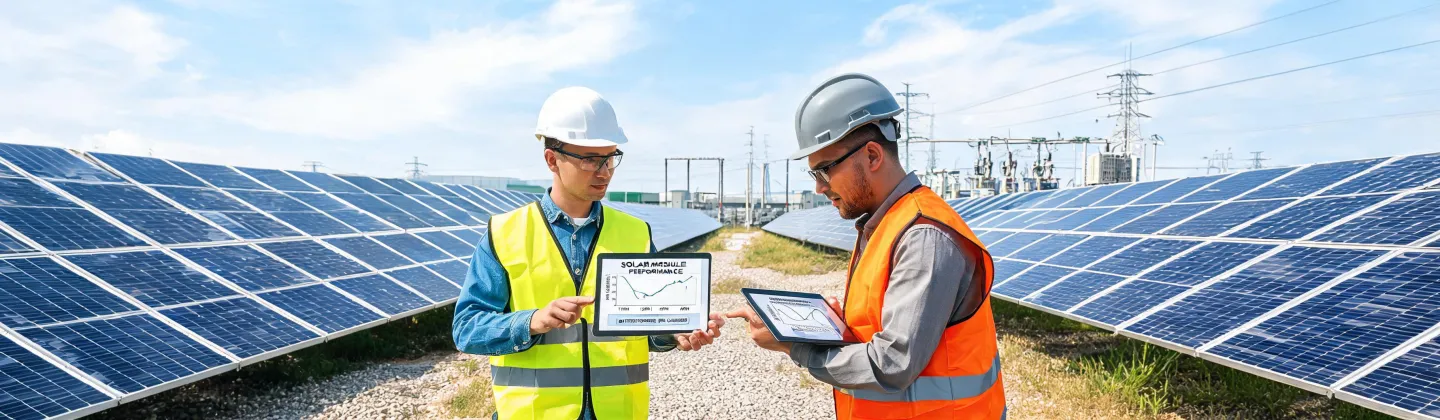
I've been reviewing solar module quality for over six years now—roughly 200+ containers annually, checking everything from cell cracks to frame straightness. In Q1 2024 alone, I rejected about 8% of first deliveries because of cosmetic defects or power tolerance issues. But my real education didn't come from a spec sheet; it came from a project I wish I'd never signed off on.
The Project That Changed My Mind
Last summer, a developer I respect asked me to give a final quality check on a 500 kW commercial installation they were building. They'd already signed a contract with a panel supplier—let's call them Supplier X—who quoted $0.09 per watt on 540W modules. The developer was thrilled. "We're saving $15,000 upfront," he told me.
I asked to see the technical specs. They handed me a datasheet that looked copied from a 2019 brochure. LID degradation? Not mentioned. Temperature coefficient? Listed as -0.40%/°C, but no test method. I flagged it. "Just standard wording," they said. I should have pushed harder (ugh, hindsight).
The Hidden Costs Start Adding Up
We installed the system in August 2024. By November, the client noticed production was already 7% below expected yield. I ran a flash test on a random sample—the actual output at STC was 505W, not 540W. That's a 6.5% deficit. Supplier X claimed it was "within the ±3% tolerance"—but their own spec said ±3% over 540W, not below. We had no contract clause for negative tolerance. (Should mention: we didn't have a formal acceptance test procedure. That cost us.)
The inverter also had issues—it was a generic string inverter without a proper cooling design. In a 40°C ambient environment, it started derating at 30% power. We spent three weeks troubleshooting, finally replacing it with a hybrid unit.
Then came the battery. They'd chosen a no-name LiFePO4 rack, 48V 100Ah, for $1,200. By month four, BMS errors shut down the system twice. The vendor offered no local support; we had to ship the unit back to a warehouse in Texas—at our cost ($380 each way).
Total additional cost after eight months: $22,000 in rework, lost production, and logistics. The "cheap" system was now 18% more expensive than the mid-range option we had initially recommended.
The TCO Epiphany
I only fully believed in total cost of ownership after I ignored it and paid that $22,000 penalty. Since then, I've developed a simple TCO calculator for every solar procurement I advise. It includes: purchase price + shipping + installation adjustments + expected degradation over 10 years + inverter replacement + battery cycle life + support availability. (I should add that I now always include a clause for negative power tolerance verification before payment.)
What We Use Now
On a similar 350 kW project last month, we went with:
- Jinko 550W N-type modules (JKM550M-72HL4-BDVP). They're around $0.11–0.12/watt, not the cheapest, but they come with a 30-year linear power warranty and verified temperature coefficient of -0.30%/°C. Flash test on arrival: 551W average. That's real.
- SOK 48V 100Ah LiFePO4 battery ($1,499 retail). I know it's pricier upfront, but it has a built-in BMS with Bluetooth monitoring, works down to -20°C, and the vendor ships from a local warehouse (should mention: our rep is in California, and we got same-week replacement when a unit failed—that matters).
The total system cost was $0.16/watt installed—only 2% higher than the Supplier X disaster. But the projected 10-year TCO is 30% lower because of better degradation, fewer service calls, and no inverter early replacement.
A Word on Black Friday Solar Generators
I also learned the hard way about consumer-grade gear. Last Black Friday, I impulsively bought a "solar generator" for my home—a 2,400Wh all-in-one unit for $899. Looked like a steal. But the battery was 40 Ah at best, the charge controller couldn't handle a standard 400W panel, and the AC output was pure sine wave but only 1,500W continuous. After a power outage in December, it ran my fridge for 3 hours before dying. I should have spent the $1,200 on a proper inverter + battery setup. (I'm building that now with a SOK 100Ah and a Victron inverter.)
How Are Wind Turbines Installed? (A Quick Contrast)
Someone asked me recently about wind turbines. I'm not a wind expert—I'm solar—but I know the basics. Turbines require a foundation (concrete pour, rebar), a tower (lattice or monopole), and a nacelle with generator. Permitting is tougher, noise is a concern, and average installation costs are roughly $2–3 per watt for small residential turbines. For a 10 kW turbine, you're looking at $20,000–$40,000 installed. That's why I stick with solar for most commercial projects—simpler logistics, better ROI per square foot. But wind makes sense in high-wind zones with ample land. (This was accurate as of Q4 2024; turbine prices have been volatile.)
What I'd Do Differently
If I could redo that first project, I'd:
- Never sign a contract without a verified power tolerance clause.
- Demand a sample shipment for flash testing before full delivery.
- Calculate TCO including a 10% risk buffer for support gaps.
- Use branded batteries with local support—SOK or similar.
- Skip Black Friday deals on anything mission-critical. (Once bitten, twice shy.)
I still get questioned on price by clients. "Jinko costs more than X brand." My answer: "That $0.02/watt difference buys you a 30-year warranty from a Tier 1 manufacturer that actually tests every module. And I can show you the $22,000 reason why I won't go cheaper."
Like I said, I didn't fully understand TCO until a $22,000 mistake proved it to me. Hopefully, this story saves you from making the same one.