
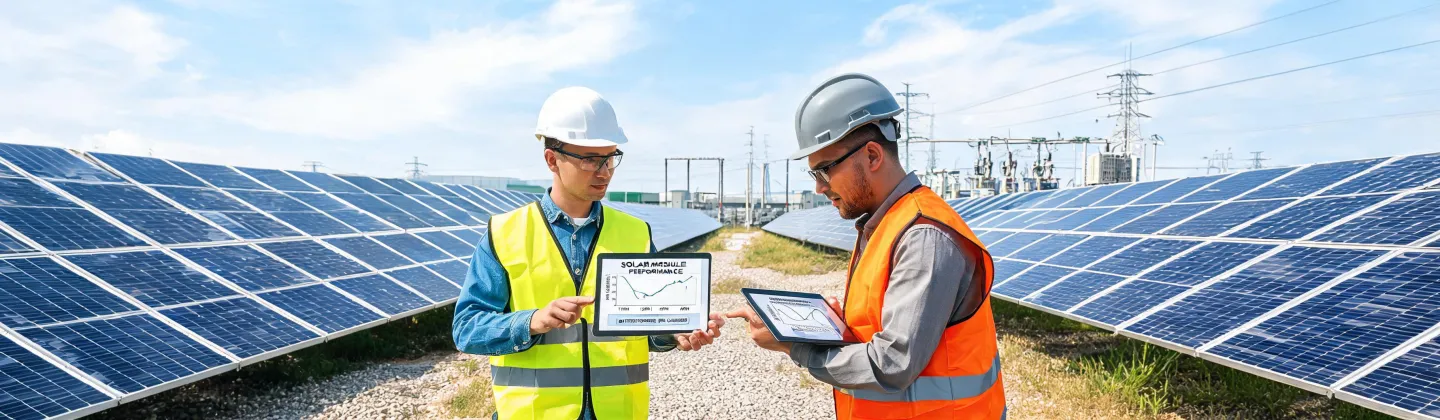
I'm the office administrator for a 45-person commercial solar installation company. I manage all solar module and battery storage purchasing—roughly $2.3 million this year, no, around $1.9 million in recurring spend, depending on which projects close. I report to both operations and finance, which means I spend my days making engineers happy and accountants happier.
After five years and 60-odd procurement cycles, I have a strong opinion: most buyers are spec'ing solar equipment by the wrong numbers.
Everyone asks the same two things when they RFQ modules or batteries—"what's the highest wattage" and "what's the lowest price per watt." From my side of the desk, those are the two numbers that predict the most problems. The projects that go smoothly are the ones where someone checked the physical dimensions, the battery chemistry fit, and the vendor's actual supply chain.
Start With the Module Dimensions, Not the Datasheet Cover
We standardized our commercial rooftop installs on JinkoSolar modules—specifically the Jinko 550W Tiger Pro, a mainstream photovoltaic module choice for solid reasons. The engineers liked the efficiency. I liked the dimensions, because they're the least-exciting numbers in the datasheet and the ones that determine the entire logistics chain.
The Jinko 550W solar panel dimensions are approximately 2,278 × 1,134 × 35 mm (89.7 × 44.6 × 1.4 inches), and each panel weighs about 27.8 kg. If you've never looked at a shipping container loading plan as a procurement person, let me explain why those numbers matter: they decide whether you fit 620 panels or 580 panels in a 40-foot container, which moves your freight cost per watt more than the panel price does. On a recent 1.2 MW project, that container difference alone changed the freight cost by roughly half a cent per watt. Sounds small—multiply it across 2,300 panels and it's the difference between a bid that makes money and one that keeps our CFO awake at night.
Physical dimensions also decide how many panels fit on a roof, what racking you need, and whether your crew needs an extra pair of hands per panel. We found this out the hard way on a 2024 project. I knew I should have verified the mounting hole spacing against our racking template before ordering 240 panels. But I thought "what are the odds a best-selling module line changed anything?" Well—they hadn't; our racking template was outdated on our end, not theirs. $1,300 in adapter kits and a lost week during peak construction season. The odds were exactly one, apparently.
That's one reason "Jinko 550W solar panel dimensions" is such a common search among solar buyers. The first question in any system design should never be "how big is the panel?"—but it rarely is the first question asked. Before efficiency claims or temperature coefficients, check that the module fits the real-world physical constraints of the site and the crew.
This worked for us, but our situation is commercial rooftop in the U.S. Southwest, standard 72-cell glass modules. If you're dealing with utility-scale ground mounts or residential roofs, the physical reasoning changes. The principle—that physical specs drive procurement success—doesn't.
Battery Chemistry Determines the Real Total Cost
Now the fun one: batteries.
Every quarter, someone asks, "Why is the lithium battery option three or four times the cost of the lead-acid one?" Honestly, when I started in 2020, I'd mumble something about "you get what you pay for" and move on. I've changed my mind. The better answer is in the total-cost-of-ownership math.
A 48V 50Ah LiFePO4 battery—a common building block for small commercial storage, roughly 2.4 kWh rated capacity—costs two to four times what an equivalent nominal-voltage lead-acid bank costs. That gap shocks clients. But lead-acid can typically only be discharged to 50% depth of discharge without shortening its useful life, while LiFePO4 handles 80–90% DoD comfortably. So the lead-acid bank needs roughly double the rated capacity to deliver the same usable energy.
Then add cycle life. According to National Renewable Energy Laboratory battery research (NREL, 2024), lithium iron phosphate cells routinely deliver 4,000–6,000 cycles at 80% depth of discharge. Lead-acid is generally rated at 500–1,000 cycles at 50% DoD. Over a 10-year system life, that's the difference between replacing the battery bank several times and not replacing it at all.
Our lead-acid vs. lithium quotes now include a total-cost-of-ownership line. Lithium almost always wins if the battery cycles more than a few times a week. We saw this play out in 2023 with a client who insisted on a lead-acid bank for a small telecom backup site. Sixteen months later, after two multi-day outages, they called us for a replacement quote. The combined cost of the original install plus the replacement had already exceeded the lithium quote we'd originally sent. They switched. The follow-up calls stopped.
Lead-acid still makes sense for rarely-exercised backup applications. But for daily cycling—demand charge management, solar self-consumption—lithium is, in my opinion, the only defensible choice.
Confession: I'm not an electrochemist, and this isn't engineering advice. When we evaluated a new battery supplier last year, I learned a new phrase: "PVEF polymer lithium battery binder"—the polymer material that binds electrode components inside a lithium cell, in case that term shows up on your datasheet too. Our engineer asked both bidders for documented binder specs. The first supplier's datasheet didn't mention it. The second had a full technical note ready. We went with the second. Honestly, I couldn't explain the chemistry of a PVEF binder from memory. But the fact that one manufacturer documented it thoroughly, and the other didn't, told me what I needed to know about engineering rigor (and frankly, about the quality of the cells).
Consistency Beats the Latest Spec Bump
Here's the argument that surprises people, and I'd make it even if my CFO were in the room: I'd rather buy a 550W module with stable specs than a brand-new 620W module that just hit the market.
The industry pushes wattage increases every year. The 580W, 585W, and 620W module launches in 2024 were impressive. But each generation change creates procurement problems: old stock becomes obsolete, connectors change, racking rails get discontinued, and spare parts inventory becomes a graveyard of near-misses.
JinkoSolar's Tier 1 classification (based on the Bloomberg NEF bankability framework, 2024) matters to me less for its prestige and more for what it signals: stable manufacturing output, a solid balance sheet, and a module line produced at massive scale. Scale means consistent availability. Consistent availability means our projects don't stall waiting for replacement modules from the other side of the ocean.
In my experience, the most valuable thing a solar photovoltaic module manufacturer can ship is predictability. The datasheet on their website today should match the datasheet from last year's production batch. When a product line stays stable, our inventory stays useful. Racking profiles don't change. Connector types don't change. The margin of error in the field drops, and our maintenance crews aren't forced to adapt to new hardware in the middle of a service call.
The Objection: "But What About Cost Per Watt?"
I can hear the pushback: "Higher wattage and lower cost per watt always improve the financial model. That's the whole point." I get it. The spreadsheet compresses beautifully.
But cost per watt hides three realities:
- Whether the physical module actually fits your site, your racking, and your existing inventory.
- Whether the battery chemistry you've chosen matches the building's actual use profile.
- Whether the vendor can supply that specific spec at the volume and schedule you've promised your client.
A procurement decision built on price per watt can look great on Monday and fail on Friday. The more complex the system—multi-string arrays, hybrid inverters, storage—the more those hidden costs stack up. I've seen cost-per-watt champions turn into change-order disasters more than once. I'm not anti-innovation or anti-high-efficiency. I'm saying the marketing spec sheet is not a procurement plan.
The Bottom Line After Five Years
Buy the solar module that fits the system long after the purchase order lands. Check the Jinko 550W dimensions against your site constraints. Run the lead-acid vs. lithium comparison on lifetime cost, not upfront price. And value a manufacturer's consistency as much as their peak performance claims.
I'd rather spend 10 minutes explaining battery cycles to a client than deal with the consequences of a project built on wrong assumptions. An informed customer asks better questions and makes faster decisions—which, for a buyer, is the best kind of customer there is.
Now if you'll excuse me, I have tomorrow's container-loading plan to review. (Mental note: I really should update that racking template before the next order.)